
Intuit Hit by Class-Action Lawsuits After 3,000 Job Cuts Amid Disruptive AI Restructuring
Aug 21, 2026Two class-action lawsuits allege Intuit misled investors about TurboTax and Mailchimp's performance as executives sold $41M in personal stock before 3,000 layoffs and a 20% stock drop.
On August 17, 2026, law practice Grant & Eisenhofer P.A. filed a new securities class-action lawsuit against Intuit Inc. (NASDAQ: INTU), expanding allegations initially raised in a previous class-action lawsuit, Baldwin v. Intuit Inc., filed earlier this year on June 20, 2026. The newer case, Bruce v. Intuit Inc., broadens the claims surrounding TurboTax’s performance and adds allegations involving Mailchimp.
Baldwin v. Intuit Inc. and Bruce v. Intuit Inc.
Both lawsuits name Intuit CEO Sasan K. Goodarzi and CFO Sandeep S. Aujla as defendants.
Baldwin v. Intuit Inc. alleges that Intuit misrepresented TurboTax’s fiscal year 2026 performance by issuing growth expectations despite knowing that the business was losing do-it-yourself customers to cheaper alternatives, facing increasing competition, and experiencing slower growth in its paid online tax services.
Bruce v. Intuit Inc. expands those allegations by focusing more directly on the growing competitive threat from generative AI tax alternatives and by adding Mailchimp to the claims. The lawsuit alleges that Intuit and its top executives misled investors about TurboTax’s performance, including the extent to which generative AI tax alternatives were contributing to customer losses in its core tax business, while also alleging that executives continued to promote Mailchimp’s growth prospects despite knowing the $12 billion platform, acquired in 2021, had been experiencing deteriorating performance and ongoing operational and integration difficulties.
The situation escalated rapidly on May 20, 2026, when Intuit disclosed weaker-than-expected TurboTax results and reduced its expected full-year revenue growth for TurboTax from 8% to 7%. The one-percentage-point reduction represented roughly $49 million less in expected annual TurboTax revenue. Intuit also said it expected total TurboTax Online users to decline about 2%, equivalent to roughly 700,000 fewer TurboTax Online filings based on the prior year’s 34.9 million, while its pay-nothing customer base fell by roughly 1 million users.
Intuit also reported 19% growth in Online Ecosystem revenue, while highlighting to investors that growth would have been 22% excluding Mailchimp, showing how much Mailchimp was slowing the growth of the broader business. Intuit had also previously explored selling Mailchimp, but was unable to find a buyer willing to pay a price the company considered attractive. After those efforts failed, Intuit decided to reduce investment in Mailchimp and shift resources elsewhere.
Later that same day, the company announced plans to eliminate roughly 3,000 jobs, or about 17% of its global workforce. The following trading day, Intuit’s stock fell 20.02%, from $383.93 to $307.07, and later fell as low as $252.84 during trading on June 22, about 34% below its May 20 closing price and erasing roughly $36 billion from the company’s stock market value. An investor who bought Intuit stock at $383.93 on May 20 would have been down about $131 per share at the June low. By August 20, three days after the latest lawsuit was filed, Intuit’s stock had recovered to around $362 but remained below its May 20 level, meaning investors who bought near that price had not yet fully recovered their losses.
The Allegations: $41M in Stock Sales by Intuit’s CEO and CFO
The lawsuit alleges that during the roughly nine months leading up to the May 20 disclosures, Goodarzi sold 55,756 shares for more than $36 million, while Aujla sold 8,782 shares for more than $5 million, generating more than $41 million in stock-sale proceeds between them. The sales continued as May 20 approached, when Intuit disclosed weaker TurboTax performance, Mailchimp pressures, and restructuring plans. The company’s stock then fell 20% the next trading day, wiping billions of dollars from its market value and leaving investors with substantial losses.
The significance of those sales is the timing. The lawsuits allege that Goodarzi and Aujla may have known about the weakening performance and competitive pressures affecting TurboTax and Mailchimp before the full extent and material impact of those issues were disclosed to investors. During that period, they sold more than $41 million in personal Intuit shares at prices substantially above the levels the stock reached after May 20.
If you bought Intuit stock between August 22, 2025 and May 20, 2026, you may fall within the class covered by the lawsuit. Several securities law firms are currently providing information to affected investors, including Robbins Geller Rudman & Dowd, Kessler Topaz Meltzer & Check, Faruqi & Faruqi, Kirby McInerney, Pomerantz, Levi & Korsinsky, and The Gross Law Firm.
More Revenue, Fewer Workers: Intuit Moves Beyond Its 2024 “Fire-to-Hire” Strategy
Intuit’s 2026 layoffs differ significantly from its 2024 workforce reductions. In 2024, the company eliminated roughly 1,800 roles while planning to hire approximately the same number of employees, primarily in engineering, product, and customer-facing positions. In 2026, Intuit announced approximately 3,000 job cuts while reallocating resources toward what CEO Sasan Goodarzi described in the layoff announcement as Intuit’s “3 Big Bets,” scaling its AI-native platform, becoming customers’ primary financial platform, and expanding in the mid-market.
The 2026 layoffs extend across Intuit’s organizational structure and major businesses. The company is reducing management layers and coordination-heavy roles, eliminating overlapping TurboTax and Credit Karma functions, cutting investment and staffing in Mailchimp, and streamlining parts of its engineering, product management, and design teams.
Intuit is not only compressing its organizational structure and the workforce required to perform and coordinate work, but also consolidating employees into fewer locations, including the closure of its Reno and Woodland Hills offices.
According to CEO Sasan Goodarzi, these changes are part of a broader effort to ‘fundamentally re-engineer’ Intuit’s operating model by reducing complexity, accelerating decision-making, and operating with greater velocity as a leaner company. Although Intuit did not directly frame the 2026 layoffs as AI-driven, the broader restructuring is clearly tied to its AI strategy, with roles being removed as businesses are consolidated, workflows are streamlined, and resources are redirected toward its AI-native platform and more automated, ‘done-for-you’ customer experiences.
The Financial Impact of Intuit’s AI Restructuring
Growth and layoffs are happening simultaneously. Revenue, profit, margins, and cash flow are all increasing.
FY2025 revenue increased 16%, operating income 36%, and net income 31%. During the first nine months of FY2026, revenue increased another 14%.
Most layoff savings will benefit the company’s bottom line. Management said the majority of the 2026 savings would increase profit, rather than fund replacement hiring.
Intuit generated more revenue with fewer reported employees. Revenue per year-end employee increased 19.5%, from approximately $866,000 in FY2024 to $1.04 million in FY2025.
Intuit also has substantial financial capacity to absorb restructuring costs. The company expects the 2026 restructuring to cost approximately $300–$340 million, primarily for severance payments and employee benefits associated with the workforce reduction. That represents only about 4%–4.5% of the $7.5 billion in operating cash generated during the preceding nine months.
Meanwhile, as Intuit reduces its workforce, it is also increasing technology investment. R&D, hosting, outside services, cloud commitments, and AI partnerships increased as the company streamlined its operations.
From Peak Headcount to Workforce Reduction
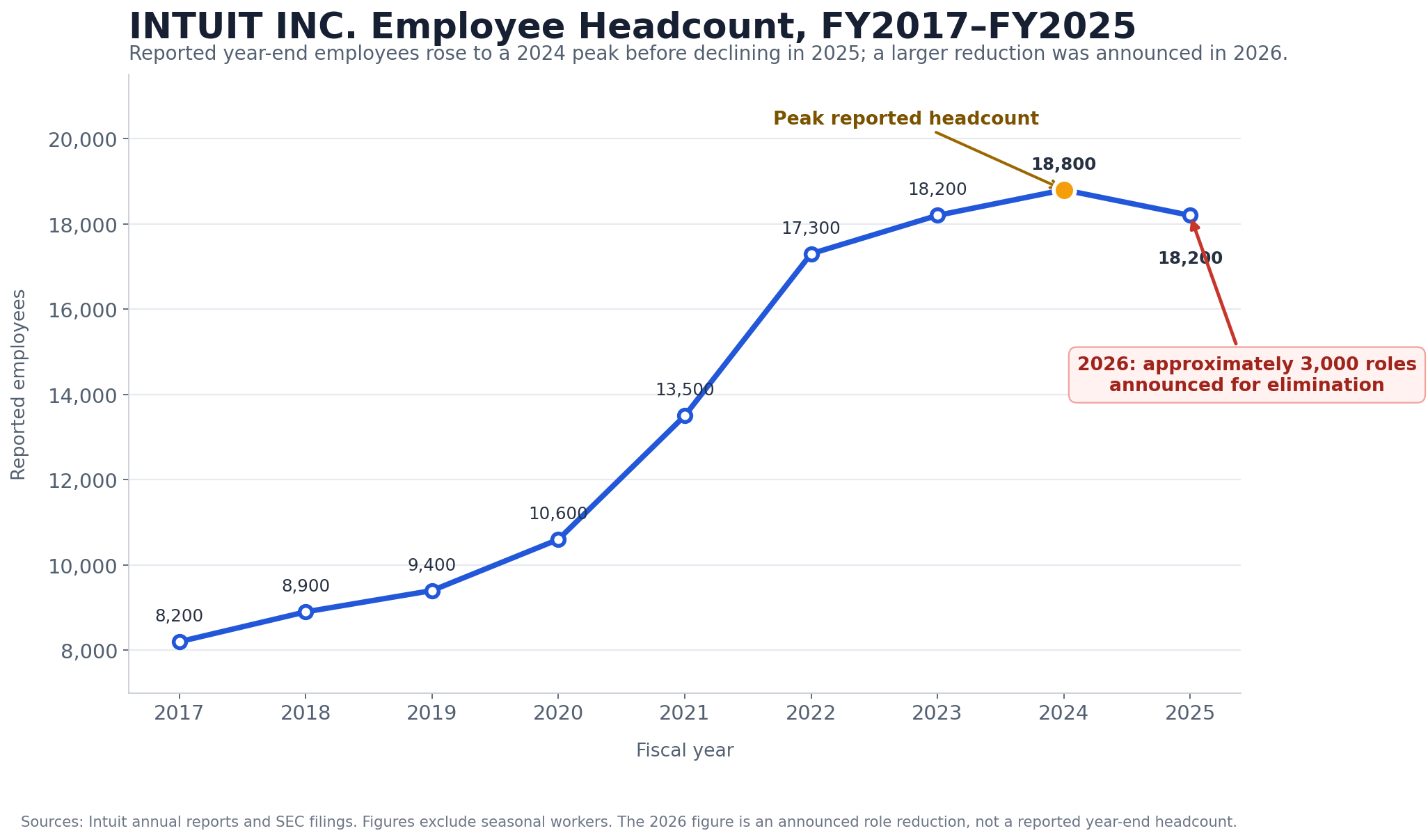
The table shows Intuit’s reported workforce expanding from 8,200 employees in 2017 to a peak of 18,800 in 2024. Headcount then declined in 2025, before Intuit announced approximately 3,000 additional role eliminations in 2026. This marks a clear reversal from net workforce expansion to contraction.
| Fiscal year | Reported employees | Annual change | Key context |
|---|---|---|---|
| 2017 | 8,200 | — | Beginning of measured period |
| 2018 | 8,900 | +700 | Workforce expansion |
| 2019 | 9,400 | +500 | Workforce expansion |
| 2020 | 10,600 | +1,200 | Workforce expansion |
| 2021 | 13,500 | +2,900 | Credit Karma acquisition contributed to growth |
| 2022 | 17,300 | +3,800 | Mailchimp acquisition contributed to growth |
| 2023 | 18,200 | +900 | Continued expansion |
| 2024 | 18,800 | +600 | Peak reported headcount |
| 2025 | 18,200 | −600 | Workforce contraction begins |
| 2026 | Not yet reported | Approximately 3,000 roles announced for elimination | 17% workforce restructuring |
The graph below shows Intuit’s workforce expanding until it reached a peak, followed by a clear reversal into workforce reduction.
How AI Is Reshaping Intuit’s Workforce, Products, and Business Value
AI enables companies to generate greater financial returns by increasing productivity and operating leverage, allowing them to accomplish more with fewer people. But the economic effects of AI extend beyond productivity and workforce efficiency. AI is also changing where companies direct capital, how products compete, and which businesses gain or lose market value. Intuit provides a clear example of all three dynamics.
As a financial technology company serving approximately 100 million consumers, mid-market businesses, and accounting professionals, Intuit operates across several major products that are being affected differently by Intuit’s AI restructuring. Its principal brands and products include:
-
TurboTax: Personal tax preparation and filing.
-
Credit Karma: Credit scores, financial monitoring, and personalized financial-product recommendations.
-
QuickBooks: Accounting, payroll, payments, and money-management services for businesses.
-
Mailchimp: Email marketing, customer management, and marketing automation.
-
Intuit Enterprise Suite: Financial and operational management for mid-sized businesses.
-
ProConnect Tax: Cloud-based professional tax software.
-
Lacerte: Professional tax-preparation software for complex returns.
-
ProSeries: Professional tax-preparation software for accounting firms.
Uneven Growth Across Intuit’s Businesses
| Segment | 2026 Performance Trend | What's Actually Happening |
|---|---|---|
| Total Intuit Corp. | 🟢 Up 13%–14% | Making more money overall, driven by stronger growth across other parts of the business. |
| TurboTax | 🟡 Slowing (Up ~7%) | Losing market share and DIY users to lower-priced competitors. |
| Mailchimp | 🔴 Dragging Growth | Underperforming; Intuit is scaling back investment. |
| QuickBooks / Online Ecosystem | 🚀 Up 19% | A major growth engine helping keep Intuit's overall growth high. |
Intuit’s AI Restructuring: Integrating Products and Reducing Its Workforce
Intuit has moved away from operating TurboTax, Credit Karma, QuickBooks, Mailchimp, and its other products as entirely separate businesses and is continuing to integrate them into its broader AI-driven expert platform. This integration is central to its AI strategy because it brings together products, customer data, workflows, and its network of AI-enabled financial, tax, and bookkeeping experts within a more unified platform.
For example, Credit Karma members and QuickBooks users can file their taxes through TurboTax without leaving those services. Businesses can connect QuickBooks customer and sales information with Mailchimp, while accountants can transfer QuickBooks records into ProConnect to prepare tax returns. These integrations allow Intuit’s AI agents to operate across multiple products rather than within the boundaries of a single service. GenOS provides the internal AI infrastructure Intuit uses to build, test, and deploy those agents across its businesses, while on the customer-facing side, the integration allows customers to use more of Intuit’s services within one unified ecosystem.
That same AI-driven restructuring that is changing how Intuit delivers its services is also changing how much human work is required to provide them. One of the clearest examples is Intuit’s Expert Network, which includes thousands of tax, bookkeeping, and financial professionals whose feedback and judgment are used to train, evaluate, and continuously improve its AI models.
Intuit describes this as “architecting the feedback loops” between its experts and the teams building and improving its AI systems. Through these feedback loops, Intuit captures expert corrections and judgment and feeds that expertise back into its AI systems. Intuit uses input from its experts to improve the AI’s capability to perform more financial work autonomously, reducing the amount of human involvement previously required.
The Bottom Line
Intuit’s AI restructuring is driving greater integration across the business, redirecting capital toward technology, increasingly expanding how much work AI can take over, and reducing the amount of human labor required. Beyond AI’s impact on how work is restructured and performed, the broader AI era is changing which products and businesses retain their competitive leverage, as AI lowers barriers to entry and enables more companies to enter the market, challenging the position of established products.
These changes are becoming increasingly consequential for employees, customers, and investors, making honest and transparent leadership more important as companies restructure around AI.
The market value of human work is clearly shifting, leaving employees across industries increasingly exposed to disruption in their roles and economic leverage in the labor market, and making it more important to understand where human advantage is moving next.
→ Explore the Intuitive Advantage